
On 26 May, the Delta Programme Commissioner visited the Vechtstromen district water board, at the invitation of its chair, Stefan Kuks. The visit was focused on the Twente Climate Active Cities Partnership (KAS Twente). Two projects – the Doorbraak and the Kristalbad – were visited. Both these projects have been initiated by KAS Twente and the Living Lab, which is supported by the Spatial Adaptation programme, a component of the Delta Programme. These two impressive projects demonstrate that the “elevated delta” is also expending substantial efforts on spatial adaptation.
The working visit commenced in the district water board office. Stefan Kuks first outlined the area that falls under the responsibility of the water board, whereupon he explained the taskings under the Delta Programme, and the pluvial flooding issues.
The schedule next featured a field trip to the Doorbraak project. The Doorbraak is a newly excavated, 13 km long water course in the outskirts of Almelo. This water course will ensure that the residents of Almelo will keep their feet dry, while at the same time provide an ecological connection between Twente and the Sallandse Heuvelrug National Park. This project is in its final stage of completion. More information is provided at the De Doorbraak web site (in Dutch).
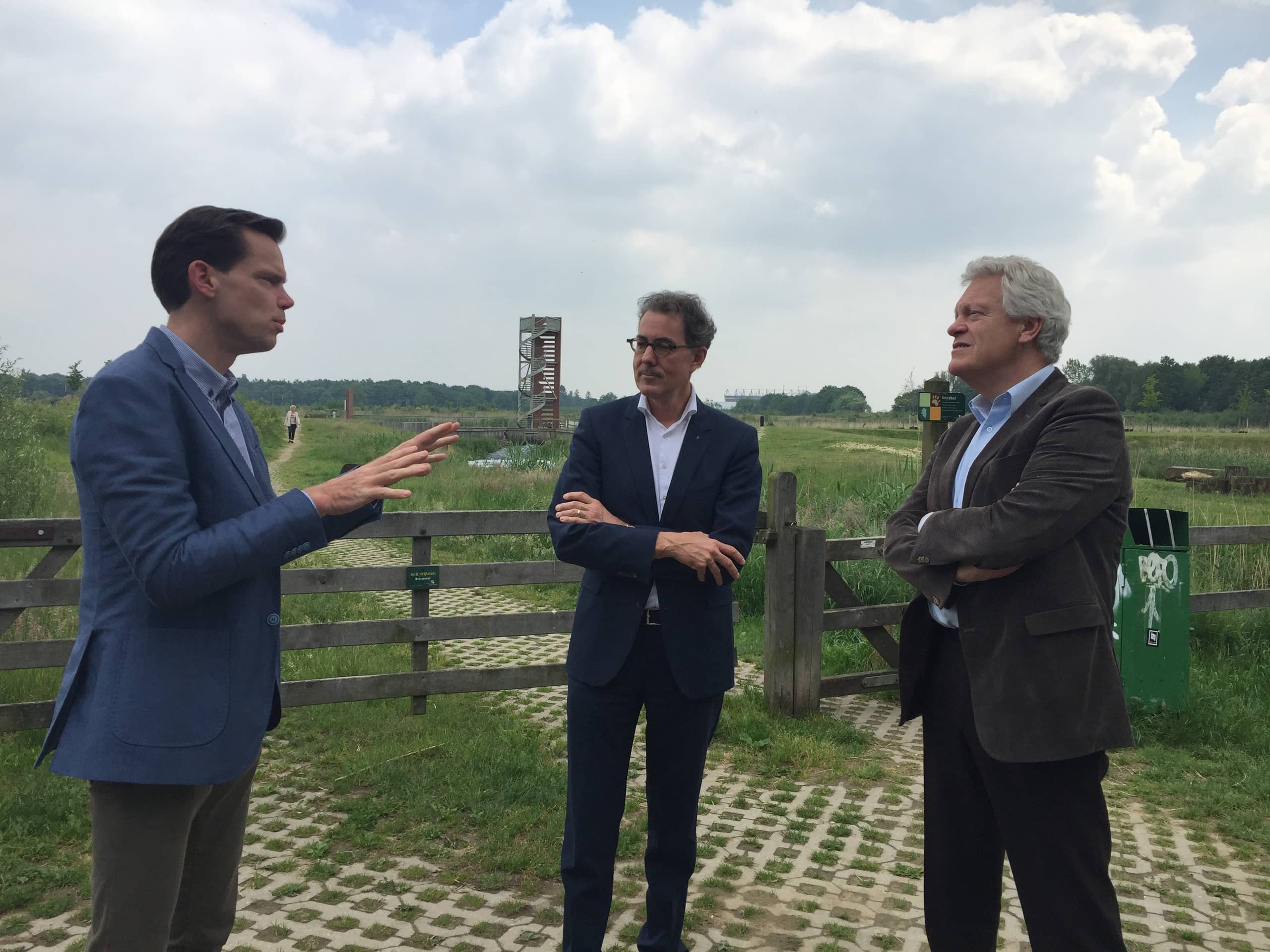
The party subsequently visited the Kristalbad project, a retention area covering 40 hectares in the transitional zone between the cities of Enschede, located upstream, and Hengelo, located downstream. This area will be providing some 187,000 m³ of additional water storage, with a view to the increasing volumes of rain water in the event of extreme downpours. This water storage will be combined with water purification, recreation, and an ecological corridor. A biological plant for the purification of sanitation water (effluent) on this scale is unique in the Netherlands. For more information, refer to the web page of the Vechtstromen district water board (in Dutch).
The working visit was rounded off at Twente University. The participants agreed that creating room for water in the elevated parts of the Netherlands, especially around the cities, is vital to combat pluvial flooding in the cities and thus foster climate adaptation. Another conclusion was that “shared ownership” is essential in this respect. “KAS Twente is well aware of the fact that we need to steer a different course in this area, or else we will not achieve anything. None of the parties can manage on its own. Only by collaborating, by involving society, and adapting flexibly to options and opportunities can we make progress.”