
On Monday 27 June, Gelderland provincial executive members Josan Meijers and Jan Jacob van Dijk welcomed the Delta Programme Commissioner and his Director to the IJsselpoort River Climate Park. They did so on behalf of the other parties involved in the River Climate Park: Natuurmonumenten (nature conservation society), Staatsbosbeheer (national forest service), the municipalities of Arnhem, Rheden, Westervoort and Zevenaar, Rijkswaterstaat (the executive arm of the Ministry of Infrastructure and the Environment) and the Rijn & IJssel Water Board.
The IJsselpoort River Climate Park stretches from where the IJssel branches off from the Rhine to the village of Giesbeek. The linking of dykes, railway tracks and roads, and bridges and ports means that there is little room to provide the IJssel with a larger drainage basin for discharging high volumes of water. The River Climate Park can provide such opportunities. Natuurmonumenten and Staatsbosbeheer started drawing up the vision for the IJsselpoort River Climate Park area in 2010. To this end, there was intensive collaboration between the aforementioned municipalities, the province and the water board. The vision for the IJsselpoort River Climate Park area is included in the preferential strategies for the Rivers sub-programme. And, in November 2015, a MIRT (Multi-year Programme for Infrastructure, Spatial Planning and Transport) Consultation Committee decided to launch an MIRT study.
The working visit began at the Natuurmonumenten visitors’ centre in Rheden where the Delta Programme Commissioner and his Director were given further information about the challenges and interests at stake. For the River Climate Park, these concern nature, water, recreation and the economy and industry; they are varied, sometimes overlapping, sometimes in conflict or interdependent. This demands an integrated approach in which the challenges and interests can be brought into proper alignment. In this way, the tasking of the Delta Programme in this area can be combined with improving spatial quality.
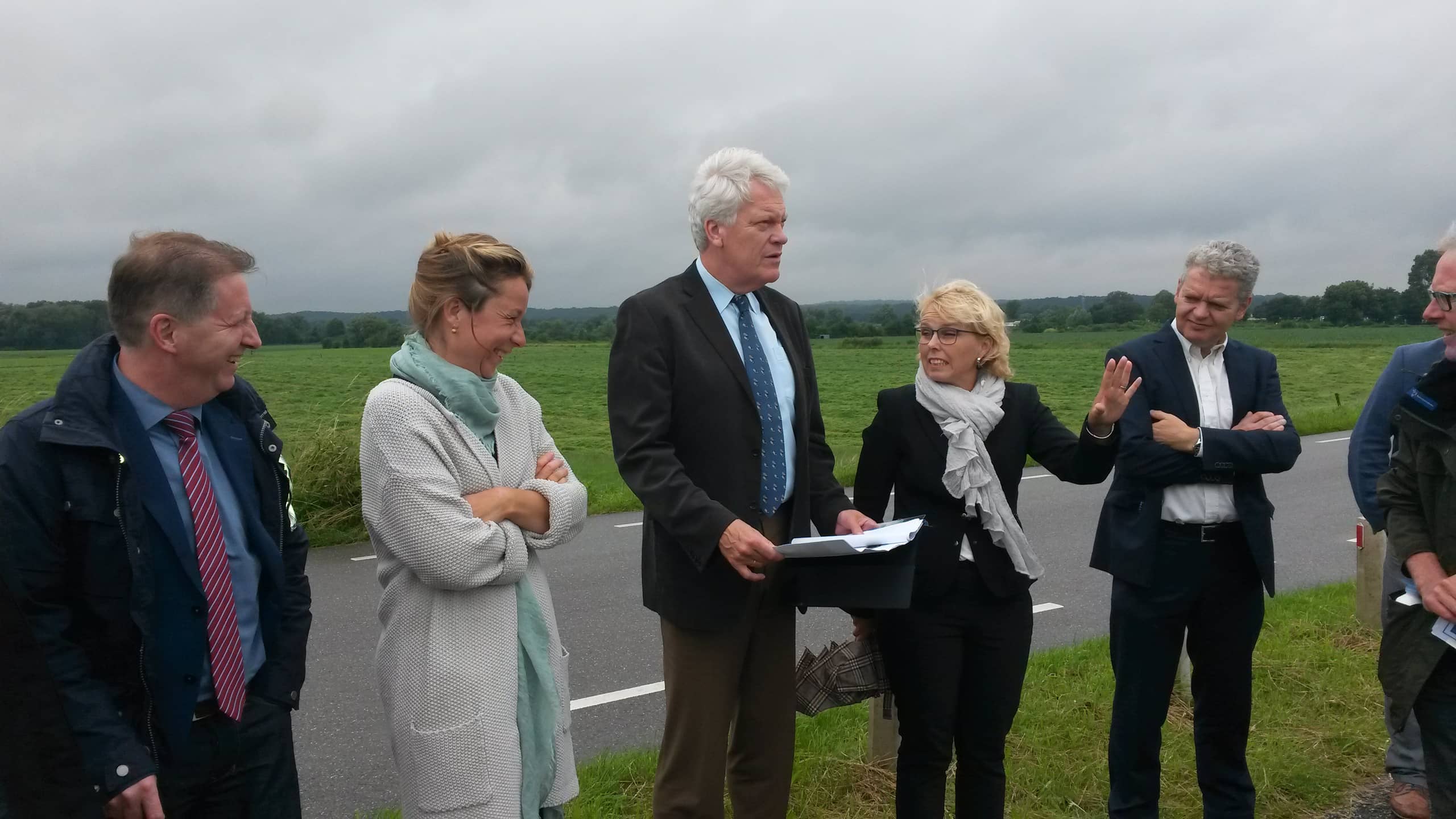
The visitors were then taken on a bus tour of the River Climate Park. Members of the municipal executive and representatives of Natuurmonumenten explained what was going on in various places. For example, they looked at the Koppenwaard (former brickworks) sub-area (see photo) where there are plans for nature development in combination with more room for the IJssel river and providing better access to recreational activities in the area.
Finally, at De Verzameling conference centre in Westervoort, the councillors spoke with the Delta Programme Commissioner and his Director about the collaboration. What is special about this project is that Natuurmonumenten and Staatsbosbeheer took the initiative for creating the River Climate Park some time ago and the project is still running. A powerful, co-creative collaboration has grown from this initiative involving the previously mentioned organisations, the province and municipalities. It is a fine example of “climate inclusive” planning and development combined with improving the spatial quality of the area.