
On 15 September, the Delta Programme Commissioner visited the Hunze & Aa’s Water Authority at the invitation of its chair, Alfred van Hall. The focus of the visit was on the Groene Dollarddijk (broad green dyke), part of the Wadden Sea Dykes general exploration. In this study, among other things, new dyke concepts are being used to find faster, better and more cost-effective ways of strengthening the dykes within dyke ring 6 and similar dyke sections in the Netherlands.
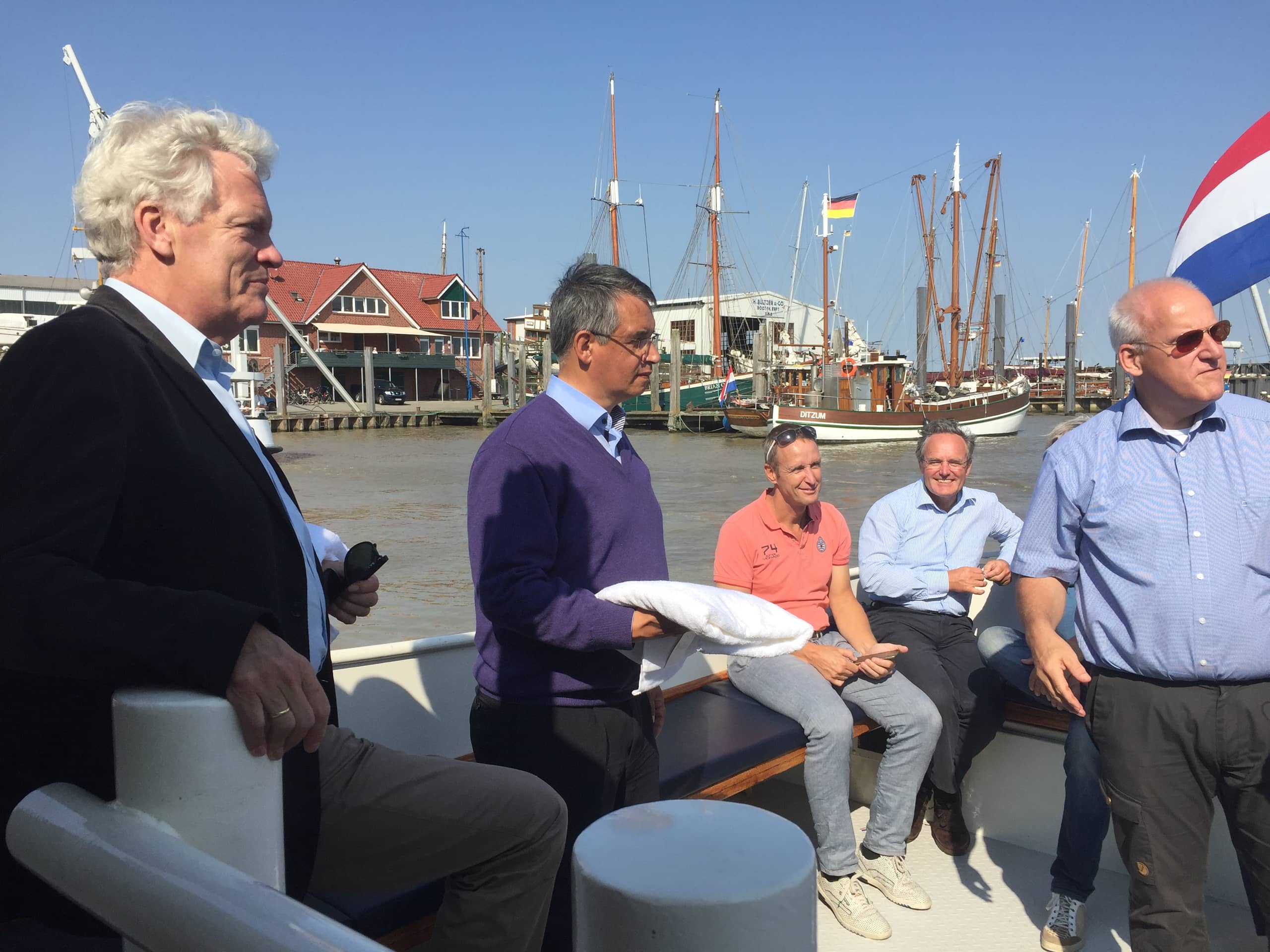
The working visit started on board the MS Westerwolde in Nieuwe Statenzijl where Alfred van Hall welcomed Wim Kuijken and the rest of the group: Hilbrand Sinnema and Wiebe van de Ploeg (members of the Executive Board of the water authority), Harm Küpers, Rombout Jongejans and Jan van der Laan (administrative support of the water authority), Bert Middel (chair of the Noorderzijlvest Water Authority), Ruud de Jong (programme manager of the Wadden Region sub-programme) and Lilianne van Sprundel (member of the Delta Programme Commissioner’s staff). After the word of welcome, the group sailed through the locks onto the Dollard and headed towards the Ems. Along the way there was plenty of opportunity for brief explanations, getting to know one another and catching up on the issues the region – and the Delta Programme – are tackling, including the Groene Dollardijk and the so-called Kleirijperij (place for clay to ripen).
The Groene Dollarddijk project links flood risk management and improving the quality of the Ems-Dollard estuary, and is also investigating innovative solutions. A great deal of clay is needed to construct the green dyke and the water authority intends to harvest it locally. This will avoid many thousands of lorry journeys. The clay will be harvested from salt marshes, and made from sediment from the Breebaart polder and saline dredge spoil from the Delfzijl port. The Kleirijperij project has been initiated to this end. At two sites, it explores the best method for making clay from sediment. Kleirijperij is a collaborative project involving the Hunze & Aa’s Water Authority, Rijkswaterstaat, Groningen Seaports, the province of Groningen, Groninger Landschap, and the Ecoshape Foundation. Using dredge spoil as a source of clay for dykes fits in perfectly with the aim of reducing the turpidity of the Ems-Dollard. From 2022, every year 1 million tons of sediment will be extracted from the Ems-Dollard. An economically viable use needs to be found for this sediment and clay for dykes is a promising option.
Bert Middel also explained the link with the Eemshaven-Delfzijl dyke improvement tasking in which plans for a Rijke Dijk (Rich Revetment) and a Dubbele Dijk (Double Dyke) – that are also part of the Wadden Sea Dykes general exploration – are being elaborated.
The working visit ended at the port town of Ditzu, in Germany where the Delta Programme Commissioner thanked Alfred van Hall for the visit. He also thanked all those present for the relaxed way in which they had exchanged information about the tasks facing the Delta Programme in the Wadden region. In this regard, everyone in attendance agreed with the conclusion that all parties will continue to need one another.