
On 4 October, Gerard Doornbos, Chair of the Rijnland District Water Board, and Caroline van de Wiel, Secretary to the General Director, received the Delta Programme Commissioner in the Haarlemmermeerpolder. The agenda featured the topics of pluvial flooding, water availability, and flood defence. The Delta Programme Commissioner was accompanied by Egon Ariens, Programme Manager for the Freshwater Supply Delta Programme, and Lars Couvreur, Project Leader for the Delta Plan on Spatial Adaptation.
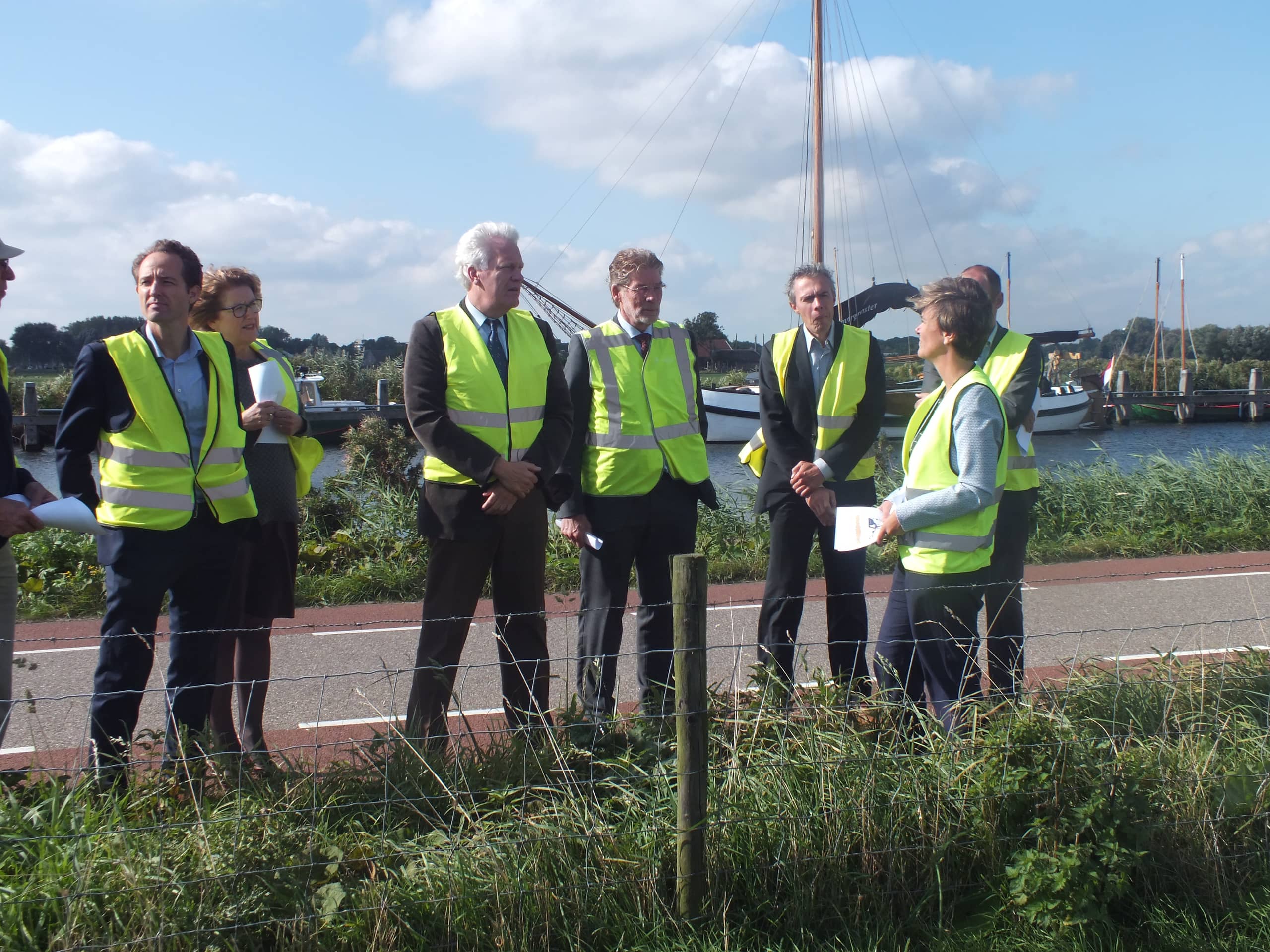
The approach to pluvial flooding was explained at the Leeghwater pumping station. An appropriate venue, as this is where the reclamation of the Haarlemmermeer lake commenced, more than 160 years ago. Consequently, water issues are not new to the area, but climate change has exacerbated the tasking. In many polders, additional efforts are required as a result of the climate change that has already set in. This task is not just incumbent upon the water authorities: in some cases, municipalities and residents have to do their part. The most efficient solution calls for a tailor-made approach, to be set down in consultation with the area concerned. Currently, investments have already been made in the central Rijnland polder drainage system, in order to ensure its climate resilience up to 2050. An example is the peak storage basin in the Haarlemmermeerpolder, which is capable of storing more than 1 million m3 of water, approx. once every 15 years. The party visited the location, where they spoke with the consultative group of residents and farmers. The latter emphasised the importance of involving the region and pointed out that alongside water management, aspects such as recreational pressure and farm management also require attention.
Subsequently, the topic of water availability was discussed at the premises of Peter Baars floriculture, with representatives of the growers and farmers who are dependent on fresh water. The fact is that brackish groundwater comes to the surface at many locations in the Haarlemmermeerpolder. For that reason, the polder requires freshwater flushing in order to enable agriculture and Nature development. Subsequently, the salt from the polder needs to be flushed out of the storage basin, which also requires water (approx. 40 million m3 per annum). The district water board and the farmers have joined forces to explore more efficient solutions to tackling brackish water and flushing. Both parties indicate that they have learned a great deal from one another. However, they have also come to the conclusion that not much is known yet about, for example, the salt damage of various functions. The process enhances the commitment to the tasking and the opportunities, such as a more tailored approach to flushing, and encouraging and utilising measurements by farmers. At the same time, the growers emphasised that it is imperative to take account of pluvial flooding in the discussions on water availability. Water management must be geared to the integrated tasking.
The final topic of regional flood defences was discussed at the dyke that protects Schiphol Airport from the water in the storage basin, whose elevation is more than five metres higher than the airport. Regional flood defences that fall under the responsibility of provinces and district water boards are often regarded as measures to contain pluvial flooding, but deep polders adjacent to large lakes may even face the risk of local casualties. Furthermore, failure of a regional flood defence system could cause considerable economic damage to the extent of hundreds of millions or even more than a billion euros; for example, if Schiphol Airport were to be affected by pluvial flooding. In the debate on this topic, it was pointed out that regional flood defences in various areas require more attention, especially with respect to vital and vulnerable infrastructure. This is an item that could be addressed in the elaboration of the Delta Plan on Spatial Adaptation.
The working visit underscored that the national government, regional authorities, and consumers sorely need one another in the Delta Programme, and that they all have their own well-defined tasks. The climate adaptation issue in the Haarlemmermeerpolder elucidated the taskings and the need to reinforce one another in a highly illustrative manner.